Makeup · Foundation
How to Find Foundation Undertone (and Match Your Shade)
Learning how to find foundation undertone takes two pieces of information and one non-negotiable physical check. First, identify your skin's depth range (light, medium, or deep) and undertone (warm, cool, neutral, or olive) to narrow an overwhelming display down to two or three bottles. Second, swatch those candidates along your jawline in natural daylight and wait 15 minutes for oxidation—because no photo app, including GlowMap, can replace that final real-world test.
Updated 2026-11-26 · GlowMap Editorial Team
Quick answer
- Step 1 — Depth range: Identify whether your bare skin is light, medium, or deep to pick the right row of shades.
- Step 2 — Undertone: Match warm (golden/yellow), cool (rosy/pink), neutral (balanced), or olive (subtle greenish cast) to pick the right column.
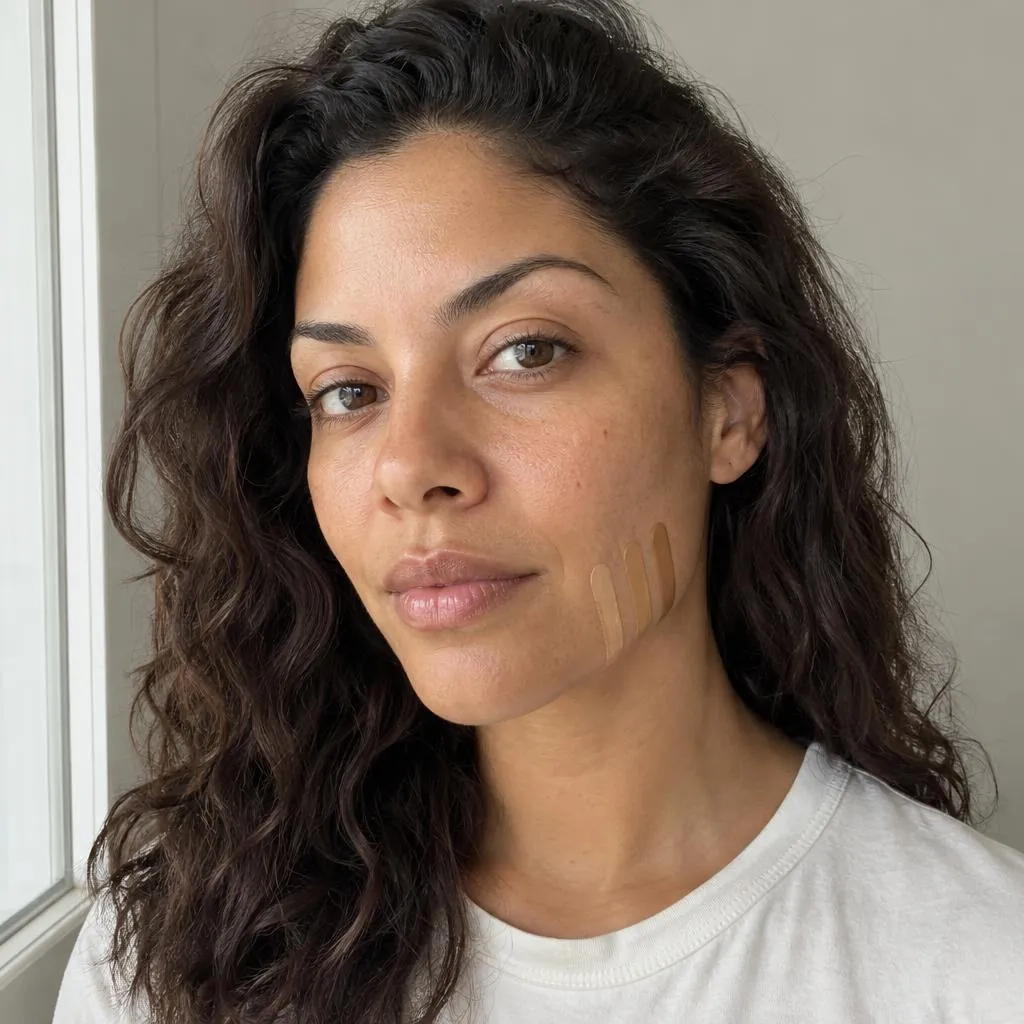
- Step 3 — Jawline daylight swatch: Apply two or three candidate stripes from lower cheek onto your neck in natural window light; the winner disappears.
- Wait 15 minutes for oxidation: Many liquid foundations darken or turn slightly warmer as volatile ingredients evaporate and interact with skin oils.
- Honest photo limit: GlowMap gives your depth range and undertone—never an exact foundation shade number—and measures your photo strictly on-device so it never leaves your phone.
Depth range and undertone: the two coordinates on every bottle
Every foundation shade is built from two variables: depth (how light or dark the pigment is) and undertone (the subtle hue mixed behind it). Getting depth wrong creates a stark mask line along your jaw. Getting undertone wrong is sneakier and far more common: the shade looks close in the bottle, yet turns noticeably orange, rosy, or gray once blended across your whole face.
| Undertone | How it looks on bare skin | Common bottle codes | Sign you picked the wrong one |
|---|---|---|---|
| Warm | Golden, yellow, honey, or peachy base | W, Warm, Golden, Y, Yellow, Peach | Too-cool shades look chalky, pink, or dull gray |
| Cool | Rosy, pink, or subtle bluish base | C, Cool, Rosy, R, Pink | Too-warm shades look sallow, yellow, or muddy orange |
| Neutral | Balanced between yellow and pink | N, Neutral, Beige, Natural | Strong W looks yellow; strong C looks visibly pink |
| Olive | Subtle greenish or muted grayish-yellow cast | O, Olive (sometimes blended into Neutral) | Warm bottles turn pumpkin-orange; cool bottles turn chalky pink |
Keep in mind that cosmetic lines do not share a universal numbering system—a 'Medium 30' or '2N' in one formula can look two shades lighter or warmer in another. And remember a core rule from personal color analysis: your color season does not decide your foundation shade. Every season exists across all skin depths, so two people in Deep Autumn or Cool Summer can wear completely different foundation depths while sharing the same lipstick palette.
How to narrow down your undertone before shopping
Before you stand under misleading store spotlights, narrow down your undertone in natural window light at home. Look at your neck and upper chest alongside your bare face—especially if your cheeks have surface redness that can disguise a warm or neutral undertone underneath.
- Check your white vs. cream reaction: Does stark pure white look crisp against your bare skin (leaning cool), or does soft cream/ivory look smoother (leaning warm)?
- Check metals next to bare skin: Run our gold vs. silver test in daylight. Yellow gold favors warm undertones, silver favors cool undertones, and looking equally good in both points toward neutral.
- Audit old foundation mistakes: Pull out a bottle that never looked quite right. If it looked orange or yellow, move cooler or more neutral; if it looked pink or ashy, move warmer or toward olive.
- Watch for subtle olive casts: If every standard warm shade looks orange and every cool shade looks pink, test olive-labeled or muted neutral bottles—many olive wearers land in neutral-leaning seasons like Soft Autumn.
The 5-step jawline swatch test in natural daylight
Once you know your depth range and undertone, you only need to test two or three candidate bottles—your best match plus one slight neighbor on either side. This five-step jawline check takes five minutes and prevents almost every bad purchase:
- 1
Start on bare, moisturized skin
Skip testing over existing foundation or tinted sunscreen, which alters both depth and undertone immediately.
- 2
Stripe three shades side by side on your jawline
Draw thin vertical stripes from the lower cheek right over your jawbone onto the top of your neck. Never test on the back of your hand or inner wrist—those areas rarely match your face.
- 3
Blend the edges lightly
Tap the borders with a clean fingertip so you see the shade at realistic wearable coverage rather than a thick opaque blob.
- 4
Step into natural daylight
Walk right up to a storefront window or step outside with a hand mirror. Overhead retail bulbs and warm bathroom lights hide orange and gray mismatches completely.
- 5
Wait 15 minutes before deciding
Let the swatches dry down fully to catch oxidation. The winning shade vanishes where cheek meets neck.
Understanding high contrast vs. low contrast also helps with coverage choice: low-contrast faces often look freshest in sheer-to-light skin tints where natural softness shows through, while higher-contrast coloring handles fuller satin or matte finishes effortlessly.
Oxidation: why a perfect match turns orange an hour later
Have you ever left a store thrilled with a match, only to catch your reflection two hours later looking visibly darker or orange around your nose and chin? That shift is foundation oxidation. As water and volatile silicones evaporate after application, pigments concentrate—and iron oxides in the formula react with oxygen, skin pH, and natural sebum.
- Always test dry-down: Waiting 15 to 20 minutes during your jawline test catches most oxidizing formulas before you pay for a full bottle.
- Oily skin oxidizes faster: Excess sebum speeds up pigment darkening. Blotting before application and using a lightweight oil-controlling primer slows the shift down.
- Fix an oxidizing favorite: If you love a formula's texture despite mild darkening, step half a shade lighter in the same undertone, or keep blotting papers handy through the afternoon.
Why no photo app can give an exact foundation shade number
Many online tools promise to scan a quick selfie and name an exact shade code across dozens of cosmetic brands. We believe in being completely upfront about why that falls short. Every smartphone camera runs automatic white balance, exposure curves, and subtle skin smoothing; every room adds its own color cast; every display renders colors differently; and every formula dries and oxidizes uniquely on real skin.
What GlowMap's calibrated photo delivers
- Your skin depth range: light, medium, or deep
- Your undertone direction: warm, cool, or neutral
- White-paper and screen-flash calibration that cancels ambient lighting casts
- Full on-device privacy—your photo never leaves your phone
What no photo analysis can reliably promise
- An exact foundation shade number or brand-specific code
- Guaranteed cross-brand shade conversions
- Prediction of how a formula will oxidize on your skin oils
- A substitute for a 5-minute daylight jawline swatch
Getting your depth range and undertone right eliminates roughly 85% of the wrong bottles before you ever pick up a tester. Even if you book an in-person draping session—as we note in online color analysis vs. in-person—foundation matching still finishes with real skin swatches in daylight.
Pairing finish and prep with your skin type
Matching how to find foundation undertone solves color, while matching texture solves wearability. The exact same shade looks seamless in one finish and patchy in another depending on skin hydration:
| Skin type | Best foundation finish | Prep and setting tip |
|---|---|---|
| Oily | Soft matte or natural-matte, oil-free | Lightweight gel moisturizer; set T-zone lightly with finely milled powder |
| Dry | Luminous, dewy, or hydrating satin | Rich moisturizer first; skip heavy powder or dust only around nose creases |
| Combination | Natural satin or flexible medium coverage | Hydrate cheeks well and target setting powder strictly to shiny zones |
| Mature | Sheer-to-medium radiant satin | Thin layers build far cleaner than one thick coat; minimize heavy powder |
Once your base disappears cleanly into your skin, the rest of your look—lipstick, blush, bronzer, and eyeshadow—flows directly from your match among the 12 color seasons. Start your free online analysis in natural window light whenever you are ready to map both your undertone and your seasonal palette.
Frequently asked questions
How do I know if my foundation undertone is warm, cool, or neutral?
Check bare skin in natural window daylight using multiple clues: pure white vs. cream fabric, gold vs. silver jewelry next to your face, and how past foundations looked (too orange means you need cooler or neutral; too pink or gray means you need warmer or olive). Confirm by swatching two or three candidates along your jawline.
Where should I swatch foundation to test the shade?
Always swatch thin vertical stripes along your jawline, blending slightly from your lower cheek onto the top of your neck, then step into natural daylight. Never rely on the back of your hand or inner wrist, which rarely match facial skin depth or undertone.
Why does my foundation look fine in the store and orange outside?
Two culprits cause this: store lighting hides undertone mismatches, and many foundations oxidize—darkening or warming up 15 to 30 minutes after contact with air and skin oils. Always check swatches in daylight and wait at least 15 minutes before buying.
What if warm foundations look orange and cool foundations look pink on me?
That classic frustration strongly suggests an olive or muted neutral undertone. Look for shades specifically labeled olive or balanced neutral, and test them on your jawline in daylight—warm and cool extremes rarely blend seamlessly on olive skin.
Does GlowMap tell me my exact foundation shade number?
No. GlowMap intentionally gives your depth range (light, medium, or deep) and undertone (warm, cool, or neutral) rather than an exact foundation shade number, because phone cameras and brand scales cannot replace a daylight jawline swatch. Your photo is measured on-device and never leaves your phone.
How does GlowMap's pricing work if I want my undertone and full color guide?
Discovering your season is free after 7 questions and 1 white-paper photo. If you want the complete report—including your depth range, undertone, contrast, sister season, 10-color palette, and makeup guidance—the full color report is a one-time payment via Stripe, with no subscription.
Read next
 Color Analysis MakeupChoose foundation by depth and undertone, and lipstick, blush, eyeshadow, and liner by your color season.
 Skin Undertone TestWarm, cool, neutral, or olive: how to run a reliable skin undertone test in natural daylight and read the results.
 Color Analysis for Olive SkinWhy olive skin confuses undertone quizzes, how to tell warm from cool olive, and which 12-season palettes flatter it.
 Color Analysis for Dark SkinHow undertone, contrast, and chroma work on deep and rich dark skin—and why every season exists across all skin depths.
 Free Online Color AnalysisHow white-paper calibration and screen-flash measurement find your color season free on your phone in 3 minutes.
Start your free calibrated analysis now.
Season, undertone, contrast, palette, and makeup guide in 3 minutes.
Start my free analysis